
Side Hustle Ideas for 2026: You’re sitting at your desk, watching the clock tick toward 5 PM, and your mind is already calculating. After taxes, after rent, after that unexpected car repair bill, there’s barely anything left. The weight of financial stress is real, and it’s heavy. I understand this feeling deeply because I have seen so many people in your exact situation, wondering if there’s a way to breathe a little easier without waiting for that annual raise that might never come.
The truth is, there are real side hustle ideas for 2026 that don’t require you to sacrifice your sanity or invest money you don’t have. These aren’t fantasies. They’re actual work that real people are doing right now, earning money that’s changing their lives in meaningful ways. Whether you’re carrying credit card debt, managing student loans, or simply trying to cover the gap between your monthly expenses and your paycheck, there’s something here waiting for you.
This article is for you. The person who believes that another income stream is possible. The person who’s willing to put in the work. Let’s explore the side hustles that truly pay, including those that pay weekly and daily online, so you can finally take control of your financial story.
Why 2026 Is Different for Side Hustle Opportunities
The landscape has shifted significantly. Technology has become more accessible, platforms have matured, and employers are increasingly open to the reality that talented people work multiple gigs. This is your advantage.
In 2026, side hustle ideas from home are no longer fringe strategies. They’re mainstream. Companies like DoorDash, Uber, Instacart, and countless freelance platforms have created an ecosystem where you don’t need permission, connections, or a fancy degree to start earning.
What’s changed in 2026:
- The average American now has 2.5 income streams instead of relying on single employment
- Technology has removed geographical barriers, allowing remote side work from anywhere
- Platforms pay weekly or daily instead of monthly, giving you faster access to money
- AI tools have reduced the barrier to entry for content creation and freelancing
- More people are open about their side hustles, removing the stigma
What’s changed is the democratization of opportunity. You can start today. Not someday. Today.
The barrier to entry for most side hustles has dropped dramatically. What once required significant capital or connections now requires primarily your time, your willingness to learn, and your commitment to consistency. This matters because it means the only real investment is your effort.
I have seen people transform their financial situations not by waiting for luck but by taking strategic action in spaces that actually reward effort. The people who succeed aren’t smarter than you. They’re simply clearer about their “why” and more intentional about their time.
Gig Economy Work: The Weekly Pay Reality
Let’s start with what most people think about first: gig work. Apps like Uber, DoorDash, Instacart, and Amazon Flex represent the most immediate way to generate income that can pay you weekly or even daily through direct deposit.
Why this works:
- You choose your hours completely
- Get paid weekly or faster (many offer daily payouts for a small fee)
- Barrier to entry is minimal (background check and driver’s license)
- No interview process or hiring delays
- Start earning within 1-2 weeks of application
- Flexible enough to fit around a 9 to 5 job
You get paid regularly. The barrier to entry is minimal (usually just a background check and valid driver’s license for delivery work).
The real experience: Marcus, a 34-year-old from Ohio, was managing $23,000 in credit card debt while working a 9 to 5 job that paid decently but not enough. He started with DoorDash on weekends, working Friday nights and Saturday afternoons. In his first month, he made $1,200. By month six, he’d structured it more strategically working 15-20 hours per week during peak times and was making $1,500 to $1,800 monthly. That extra income went directly to his debt. Within two years, he’d eliminated the credit cards.
But here’s what matters: it wasn’t just the money. It was the agency. He wasn’t waiting for a promotion. He was creating his own raise.
Gig Economy Income Comparison Table (2026)
| Platform | Best For | Peak Pay Rate | Weekly Hours for $300 | Payment Schedule | Minimum Requirements |
|---|---|---|---|---|---|
| DoorDash | Food delivery | $15-25/hour | 12-20 hours | Weekly or daily | Car, valid ID, 18+ |
| Uber Eats | Food delivery | $14-22/hour | 14-21 hours | Weekly or daily | Car, valid ID, 18+ |
| Instacart | Grocery shopping | $16-28/hour | 11-18 hours | Twice weekly | Car, valid ID, 18+ |
| Amazon Flex | Package delivery | $18-25/hour | 12-16 hours | Weekly | Car, valid ID, 21+ |
| Postmates | Multi-item delivery | $13-20/hour | 15-23 hours | Daily | Car, valid ID, 18+ |
Making this work for you:
Focus on peak hours. Evening dinner rushes (5 PM to 9 PM) and lunch rushes (11:30 AM to 1:30 PM) pay better than random times. Weather conditions matter too. Rain, snow, and holidays mean surge pricing and more generous tips.
Peak earning windows:
- Friday and Saturday evenings: 40% higher earnings potential
- Bad weather days: 30-50% surge pricing
- Holiday periods (Thanksgiving, Christmas): 2x to 3x normal rates
- Sports event days: Significant surge in food delivery
- Month-end rush: Higher tips as people restock groceries
Use multiple apps simultaneously. Drive for DoorDash one night and Uber Eats the next. This distributes your effort and keeps you from burning out on a single platform.
Track your mileage carefully. The IRS allows you to deduct either actual car expenses or the standard mileage rate (currently around 67 cents per mile for business use). This significantly reduces your tax burden at the end of the year.
Tax and mileage tracking checklist:
- Download Stride Health, MileIQ, or Everlance to automatically track mileage
- Keep screenshots of earnings from each platform monthly
- Save receipts for gas, car maintenance, phone bills
- Deduct 67 cents per business mile (2026 rate)
- Set aside 25-30% of earnings for quarterly tax payments
- Use TurboTax self-employed or hire a CPA familiar with 1099 income
Set a weekly target, not an hourly rate. If you need an extra $300 per week, you have flexibility. Some weeks you might earn it in 12 hours. Others might take 15. This psychological shift removes the pressure of “making X per hour” and focuses you on the outcome.
The honest part: Gig work is tiring. Your body will feel it. But when you’re clear that it’s temporary, when you have a specific goal (paying off debt, saving for a deposit, covering a semester of classes), the fatigue becomes purpose-driven rather than soul-crushing.
Freelancing From Your Home: Building Real Income
If your knees won’t forgive delivery driving and your schedule needs flexibility, freelancing from your home opens entirely different doors.
The side hustles that pay daily online often come through freelance platforms. Upwork, Fiverr, Freelancer, and specialized platforms like 99designs (for designers) or Toptal (for developers) connect your skills directly to people who need them right now.
The skill inventory: Start by writing down what you can do. This isn’t about being perfect. It’s about being useful.
Freelance Skills in High Demand (2026)
✍️ Writing and Content Creation
- Blog posts and articles
- Social media content
- Email copywriting
- Website copy
- Average rate: $25–75 per hour
🧑💼 Virtual Assistant Services
- Email management
- Scheduling and calendar management
- Data entry and spreadsheets
- Customer support
- Average rate: $20–50 per hour
📱 Social Media Management
- Content calendar creation
- Post scheduling
- Engagement management
- Analytics reporting
- Average rate: $30–75 per hour
🎨 Design Services
- Graphic design and Canva templates
- Logo design
- Social media graphics
- Presentation design
- Average rate: $35–100 per hour
💻 Technical Services
- Website maintenance
- Basic coding and scripting
- WordPress design
- App testing
- Average rate: $40–150 per hour
📊 Business Services
- Bookkeeping and accounting
- Research and data collection
- Customer database management
- PDF creation and formatting
- Average rate: $25–60 per hour
Every single one of those skills is money right now.
The real experience: Jennifer, 29, was drowning in student loan payments and working retail. She’d always been organized and detail-oriented. She created a Fiverr profile offering virtual assistant services: email management, scheduling, spreadsheet work, light research. She started at $25 per hour. Six months in, after delivering excellent work and building reviews, her clients were requesting her specifically at $50 to $65 per hour. Today, she works 20 hours per week doing freelance VA work and makes more than she did working 40 hours in retail. The student loans are still there, but they’re being paid down faster, and her stress level has fundamentally shifted.
Making this work for you:
Start with what you already know. You don’t need to learn complicated new skills to begin. Your current expertise, even if it seems basic, has value to someone else.
Quick win freelance starters (you can start THIS WEEK):
- Data entry and spreadsheet work: $15-35 per hour
- Proofreading and editing: $20-50 per hour
- Transcription work: $15-40 per hour
- Research tasks: $20-45 per hour
- Customer service: $16-35 per hour
- PDF formatting and document prep: $18-40 per hour
Create a lean portfolio. You don’t need a fancy website yet. A simple Upwork profile with 3-5 strong projects (even if you did them for free for friends) is enough to begin.
Underprice slightly at first. This isn’t about being exploited. It’s about building reviews and reputation. Once you have 10-15 excellent reviews and clear testimonials, you can raise your rates significantly.
Pricing progression strategy:
Phase 1 (First 10-15 projects): 20-30% below market rate to build reviews Phase 2 (Established with reviews): Market rate ($25-50/hour depending on skill) Phase 3 (Repeat clients with testimonials): 20-40% above market rate Phase 4 (Highly specialized): Negotiate premium rates
Respond quickly and professionally to inquiries. In the freelance world, your professionalism in communication often matters more than your skill level. Show up consistently, deliver on time, and communicate proactively about any issues.
How to write a winning freelance profile:
- Include a clear headline with your main skill + benefit (“I’ll boost your email management so you can focus on revenue”)
- Write a 150-word overview explaining exactly what you do and who you help
- List 3-5 specific services with pricing
- Share a professional photo (builds 27% more trust than no photo)
- Include 1-2 testimonials from previous clients (even if not paid)
- Set response time to under 1 hour for competitive advantage
Content Creation and Digital Skills
This is the space that feels most daunting because it seems like everyone’s doing it. But here’s the reality: most people start and quit within three months because they’re chasing viral moments instead of building systems.
The different approach: Instead of hoping your YouTube channel blows up, create content around specific problems people are actively paying to solve. Blog posts about side hustle ideas from home that rank in search engines. Helpful YouTube videos that get found by people searching for solutions. TikTok content that people save and share because it genuinely helped them.
The magic happens when people find your content through search engines because they’re actively looking for what you’re offering. This is fundamentally different from chasing viral clout.
Content types ranked by earning potential (2026):
| Content Type | Time to First Income | Monthly Income (Year 2) | Effort Required | Best Platforms |
|---|---|---|---|---|
| Blog/SEO Content | 3-6 months | $500-3,000+ | High consistency | Own blog, Medium |
| YouTube Videos | 4-8 months | $1,000-5,000+ | Consistent uploads | YouTube |
| Email Newsletter | 2-4 months | $300-2,000+ | Weekly writing | Substack, ConvertKit |
| TikTok/Reels | 1-3 months | $100-1,000 | Daily posting | TikTok, Instagram |
| Podcasting | 6-12 months | $500-3,000+ | Weekly episodes | Spotify, Apple |
| Online Courses | 2-4 months | $2,000-10,000+ | High initial work | Teachable, Gumroad |
Making this work for you:
Choose one platform and one format initially. If you’re not naturally a video person, start with written content. If you love video, start there. Consistency and quality matter infinitely more than spreading yourself across six platforms.
Content creation startup checklist:
For bloggers:
- Choose WordPress, Medium, or Substack
- Pick one keyword category you can write 50 articles about
- Write 2 posts per week for 12 weeks (24 posts minimum)
- Use tools: SEMrush, Ahrefs (free versions) for keyword research
- Monetize with Google AdSense, affiliate links, and sponsored posts
For YouTubers:
- Invest in basic equipment: $200-500 (good microphone matters most)
- Create 50-100 video ideas before filming first video
- Upload consistently (weekly minimum)
- Optimize titles, descriptions, and tags for search
- Use TubeBuddy or VidIQ for keyword research
For Newsletter Writers:
- Build 1,000 subscribers first (takes 3-6 months)
- Offer free lead magnet (checklist, guide, template)
- Write weekly 5-10 minute reads
- Monetize at 1,000+ subscribers ($50-500/month initially)
Solve a specific problem consistently. If you’re writing about side hustle ideas, don’t just talk generally. Share actual strategies, real numbers, and honest challenges. This builds trust faster than any motivational nonsense.
SEO signals that Google rewards heavily (2026):
- Long-form content: 3,000+ words ranks 3x better than 1,500 words
- Internal linking: Linking to 3-5 related articles boosts domain authority
- User engagement: Time on page, scroll depth, and click-through rate matter
- Mobile optimization: 60% of searches are mobile – must load fast
- Author expertise: Include author bio and credentials (builds E-E-A-T)
- Updated content: Refresh and republish old content with new year data
- Core Web Vitals: Page speed, visual stability, and interactivity scores
- Semantically related keywords: Use variations naturally, not just exact matches
- Natural linking profile: Quality backlinks from relevant authority sites
Online Tutoring and Knowledge Sharing
You know something. Maybe it’s high school math. Maybe it’s English for non-native speakers. Maybe it’s guitar, photography, or how to run a small business. That knowledge has monetary value right now.
Platforms like Chegg Tutors, Wyzant, Care.com, Tutor.com, and specialized platforms like iTalki (for language teaching) connect you with students who need help. Many of these side hustles that pay weekly or even daily are specifically designed to get money into your account quickly.
Tutoring platforms comparison (2026):
| Platform | Subject Focus | Pay Rate | Payment Frequency | Setup Time |
|---|---|---|---|---|
| Chegg Tutors | All subjects | $15-25/hour | Weekly | 1-2 days |
| Wyzant | Specialized subjects | $15-80/hour | Weekly | 3-5 days |
| iTalki | Language teaching | $10-40/hour | Weekly/bi-weekly | 1-3 days |
| Tutor.com | General academics | $14-22/hour | Weekly | 2-3 days |
| Care.com | Various subjects | $15-50/hour | Per agreement | 1-2 days |
| Superprof | Music, art, languages | $15-100/hour | Per agreement | 1-2 days |
| VIPKid (English abroad) | English only | $14-22/hour | Weekly | 3-5 days |
The real experience: David, 31, was laid off from his corporate training job and panicked. But he realized his years of corporate experience meant he could help people prepare for certifications and interviews. He joined Toptal and started taking clients at $60 per hour. His first month was slow. His third month, he had regular clients and was booked 20 hours per week. Now, he combines contract training work (through Toptal) with individual tutoring through his own website. He makes more than his old job and has complete control over his schedule.
Making this work for you:
Start with an established platform first. Building your own client base takes time. Using platforms means you get access to students immediately.
Getting approved for tutoring platforms (step-by-step):
- Choose your platform based on your subject expertise
- Prepare credentials: degree, certifications, previous teaching experience
- Write a compelling bio highlighting specific outcomes (“I helped 87% of my students raise their SAT scores by 200+ points”)
- Record a professional introduction video (under 2 minutes)
- Respond to test student sessions quickly (within 24 hours)
- Build great reviews by being patient and results-focused
- Once approved, set your rates competitively initially
- Gradually raise rates as reviews accumulate
Be specific about what you teach. “English tutoring” is vague. “English conversation practice for professionals preparing for international business” is clear and attracts the right students willing to pay better rates.
Record your sessions if allowed. As your library of student interactions grows, you can create recorded courses that become passive income.
Passive Income Progression for Tutors
- Month 1–3: Start with live one-on-one tutoring ($20–40 per hour)
- Month 3–6: Build a client base of 5–10 regular students
- Month 6–12: Create a recorded course using your best lessons
- Year 2: Sell your course to 50–100 students ($297–997), earning $15,000–100,000+ in passive income
E-Commerce and Reselling
This is the side hustle that requires more initial work but can scale significantly. It includes reselling used items, print-on-demand products, dropshipping, or curating products for specific niches.
E-commerce models ranked by startup cost (2026):
| Model | Initial Investment | Monthly Time | Monthly Income Potential | Risk Level |
|---|---|---|---|---|
| Dropshipping | $300-500 | 15-25 hours | $500-2,000 | High |
| Print-on-Demand | $0-100 | 10-20 hours | $200-1,000 | Low |
| Amazon FBA Reselling | $500-2,000 | 20-30 hours | $800-3,000 | Medium |
| Poshmark/Depop Reselling | $50-200 | 10-15 hours | $300-1,000 | Low |
| Etsy Handmade/Digital | $100-300 | 15-25 hours | $400-2,000 | Low-Medium |
| Niche Affiliate Store | $100-300 | 12-20 hours | $200-1,500 | Low |
The real approach: You’re not trying to build the next Amazon. You’re identifying a gap where you can provide value and serve a specific audience profitably.
Think about what you already know. Maybe you understand fashion and can source quality used designer items from thrift stores and resell them on Depop or Poshmark. Maybe you know about specific hobbies and can curate the best tools for beginners in that space. Maybe you can design custom t-shirts for niche communities and use print-on-demand services to fulfill orders.
Making this work for you:
Research your niche before investing. Spend two weeks watching what sells, what prices people are paying, and what problems aren’t being solved well.
Niche research process (checklist):
- Identify 3-5 potential niches you have knowledge about
- Search each niche on Amazon, eBay, Etsy, Facebook groups
- Check Google Trends for search volume (growing or declining?)
- Join relevant Reddit communities and Facebook groups
- Ask: What complaints do people have? What problems are unsolved?
- Check competitor pricing: Is there room for your margin?
- Survey 10-20 potential customers about their pain points
- Choose niche with growing demand and less competition
Start small with inventory. Don’t invest thousands upfront. Prove your concept works with limited stock first.
Use print-on-demand initially. Services like Printful, Merch by Amazon, or Teespring eliminate the need for inventory. You design, they produce and ship. You keep the margin.
Print-on-demand profit example:
Design a t-shirt and list on Merch by Amazon Cost to customer: $20 Merch by Amazon’s cost: $5 Your profit: $15 Sell 10 per day = $150 daily or $4,500 monthly
The Psychology of Starting Your Side Hustle
This is where most people fail, and I want to be honest about it. Not because the ideas don’t work. They do. But because starting requires overcoming internal resistance.
You’re tired after work. Your mind tells you it’s not the right time. You’re waiting for more money to invest, better circumstances, or some vague moment of perfect readiness that never arrives.
Here’s what I understand: the resistance is normal. It’s not a sign you should wait. It’s a sign you’re about to do something that matters.
Why people quit side hustles (real reasons):
- 34% quit because results aren’t fast enough (expected results in 1-2 months, takes 3-6)
- 28% quit because of lack of consistency (work 3 weeks hard, then stop)
- 22% quit because they underestimate time required (started with unrealistic hours)
- 16% quit because they choose wrong hustle for their personality
The reality check: You don’t need to be perfect at this. You don’t need to quit your job. You don’t need to have everything figured out. You need to start small, with one specific idea, and commit to it for 90 days before evaluating.
That’s it. Ninety days. Not forever. Not a lifestyle overhaul. Ninety days of consistent effort on one side hustle idea, and you’ll have real data about whether it works for your life.
Creating your personal system:
Write down exactly why you need this extra income. Not “I want more money.” Specifically. “I want to pay $500 per month toward my credit card debt to be free in four years instead of ten.” Specific goals fuel action.
Schedule it like a job. If you’re doing gig work, decide: Monday, Wednesday, Friday nights, 6 PM to 10 PM. If you’re freelancing, decide: 7 AM to 8 AM every weekday for client work. A system beats motivation every single time.
The 90-day side hustle launch plan:
Week 1-2: Research and setup
- Choose your side hustle idea
- Create accounts on platforms
- Set up payment/banking infrastructure
- Define your specific financial goal
Week 3-4: Testing and learning
- Complete 5-10 initial transactions/projects
- Track time and earnings carefully
- Identify what’s working and what’s not
- Make first optimization
Week 5-8: Building momentum
- Increase activity to target hours
- Implement lessons learned
- Start seeing consistent results
- Refine your process
Week 9-12: Evaluation and scaling
- Analyze complete 90-day results
- Compare actual earnings to goals
- Decide: optimize this hustle or try different one
- Plan next quarter
Track your hours and earnings. This isn’t about being obsessive. It’s about seeing progress. When you see “$347 earned this month,” it’s real. When you see the trend from month two to month three, you’ll feel motivated to push forward.
Motivational Milestone Checklist
- Earned 1 month of rent/loan payment (milestone: tangible proof)
- First $100 earned (milestone: you can do this)
- First $500 earned (milestone: this is real money)
- First $1,000 earned (milestone: monthly income boost confirmed)
- Consistent $300+ per week (milestone: life-changing income level)
Creating a System That Lasts
The final piece isn’t about finding the perfect side hustle. It’s about building a system around whatever you choose that makes it sustainable.
Most people burn out because they treat their side hustle like an emergency. Full throttle until they collapse. Then they quit, convinced it doesn’t work. But it’s not the idea that failed. It’s the system.
Build sustainability into your strategy from day one:
Protect your health. A side hustle that causes you to sleep four hours per night will destroy your primary job performance and your physical health. Work smarter, not harder. Two hours of focused, intentional work beats five hours of exhausted half-effort.
Sustainable Side Hustle Hours by Life Situation
- Freelancers: 20–30 hours per week (can offset main job if it’s gig work)
- Students: 10–15 hours per week maximum (preserve academic focus)
- Full-time workers: 10–20 hours per week maximum (prevent burnout)
- Parents: 5–15 hours per week in flexible chunks
Reinvest early wins. When you make your first $300, don’t spend it on yourself yet. Invest it in improving your hustle. Better equipment for content creation, more inventory for reselling, a course to improve your freelance skills. This compounds your results.
Smart Reinvestment Strategy
- After that: Invest 30%, allocate 70% toward your financial goals
- First $500: Invest 100% back into improving your hustle
- Second $500: Invest 80%, use 20% for yourself (motivation)
- Third $500: Invest 60%, use 40% for debt or savings
Build community. Connect with others doing the same side hustle. Join Reddit communities, Facebook groups, or local meetups. Learning from people slightly ahead of you accelerates your progress and keeps you motivated.
Best Communities for Each Hustle (2026)
- Tutoring: Teacher Facebook groups, Chegg tutor forums
- Gig Work: r/grubhub, r/doordash, r/ubereats on Reddit
- Freelancing: Upwork forums, r/freelance, industry-specific groups
- Content Creation: r/blogging, YouTube Creator Academy, Medium Writer Program
- E-commerce: r/ecommerce, r/dropshipping, Facebook seller groups
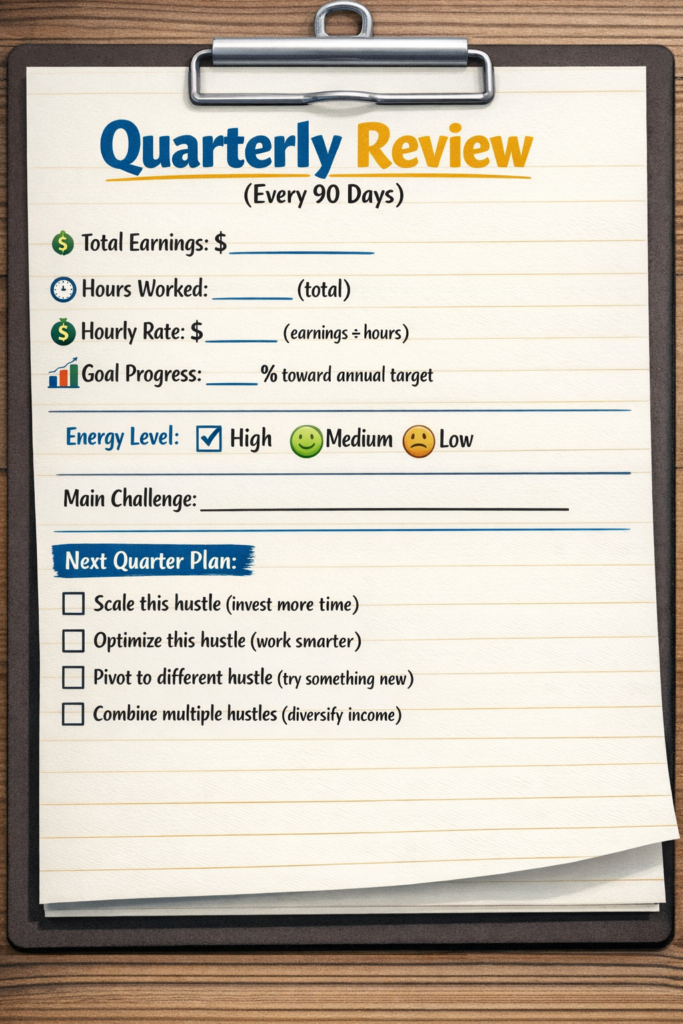
Review quarterly. Every 90 days, sit down and honestly evaluate. Is this working? Are you moving toward your goal? If not, is it the idea or the execution? Sometimes you need to pivot. But make that decision based on data, not feelings.
Quarterly review framework (every 90 days):
FAQ: Your Questions About Side Hustles in 2026
Q: How much can I realistically earn with a side hustle?
A: This depends entirely on what you choose and how much time you have. Gig work might earn you $15-25 per hour. Skilled freelancing might pay $30-100 per hour once established. E-commerce might take longer to scale but offers higher margins. Most people start with $200-500 extra per month and grow from there. The ceiling is much higher – some people earn $2,000-5,000+ monthly on side hustles within 12-24 months.
Q: How long before I see real money?
A: Gig work pays within days. Freelancing might take 2-4 weeks to land your first client. Content creation might take 3-6 months to generate meaningful income. The speed depends on the hustle. This is why starting with gig work or freelancing makes sense if you need money quickly. Most people see their first $100 within 2-4 weeks if they choose the right starting hustle.
Q: Will this affect my credit score or taxes?
A: A side hustle won’t hurt your credit unless you take on debt to start it. For taxes, you’ll need to report the income. But you can deduct legitimate business expenses (mileage, equipment, software, education). Many side hustlers owe less in taxes than they expect because of these deductions. Consult a tax professional for your specific situation. Using services like TurboTax Self-Employed ($150-180) ensures you file correctly.
Q: What if my primary job has a non-compete clause?
A: Non-competes are generally unenforceable unless you’re in a highly sensitive industry (tech, finance, pharma). But check your employment contract. Most employers don’t care if you deliver food or freelance as long as it doesn’t compete directly with your job or happen during work hours. When in doubt, ask HR directly or consult an employment lawyer (often free initial consultation).
Q: How do I balance a side hustle with a 9 to 5 job?
A: Ruthlessly protect your sleep and health. A side hustle that leaves you too exhausted to perform well at your primary job defeats the purpose. Most successful people start with 5-10 hours per week, not 30. Schedule your side hustle for times when you’re naturally most alert: some people work 5 AM before jobs, others work Friday nights and weekends.
Q: Should I quit my job to focus on the side hustle?
A: Not initially. Build your side hustle to stability while you still have the security of your primary job. Once your side income is consistent and substantial (and ideally equals your expenses), you can make that decision from a position of strength, not desperation. Most successful hustlers don’t quit their job until their side income is 50%+ of their living expenses.
Q: What if I fail at my first side hustle?
A: Failure is data. You’ll learn what doesn’t work for your personality, schedule, and skills. That information becomes invaluable for your next attempt. Almost every successful hustler failed at least once. The difference is they tried again. Expect 1-2 failed attempts before finding your winning side hustle.
Q: Which side hustle should I start with if I need money in 2 weeks?
A: Gig economy work (DoorDash, Uber, Instacart). You can be approved and earning within 5-10 days. Freelancing on Fiverr can also be fast if you have an existing skill. Avoid content creation, e-commerce, and tutoring if you need money immediately – these take longer to generate first income.
The Real Message Here
You’re not broken for struggling financially. You’re not lazy for needing extra income beyond your 9 to 5. You’re not unrealistic for wanting to take control of your financial situation. You’re actually doing exactly what millions of people are discovering in 2026: that the traditional path of relying solely on one employer is no longer the only option.
Side hustle ideas aren’t fantasies anymore. They’re legitimate strategies that real people are using to pay off debt, build emergency funds, save for houses, and create breathing room in their monthly budget. The ideas are here. The platforms are here. The opportunity is here.
What’s waiting is your decision to start.
Your action plan starting TODAY:
- Read through the 6 main side hustle categories above
- Pick ONE that resonates with your skills and schedule
- Spend 1 hour researching that specific hustle
- Sign up on the platform this week
- Commit to 90 days of consistent effort
- Track your earnings weekly
- Review results after 90 days
- Scale what works, pivot if needed
Choose one idea from this article. Not all of them. One. Give it 90 days of consistent, focused effort. Track what happens. Then decide if it’s working or if you need to adjust.
You have more power over your financial situation than you might believe right now. Not through luck. Not through waiting. Through intention and action. The side hustles of 2026 have made this possible for ordinary people like you.
My warmest salute to you for reading this far. It means you’re already thinking differently about your possibilities. That shift in thinking, that belief that things could be better, that’s where everything begins. Now take the next step. Your future self is waiting for you to decide.
Disclaimer: This article is for educational and informational purposes only. It is not financial, investment, or legal advice. Always consult a qualified financial advisor before making any financial decisions.

Richard Patterson is the founder of Payoff Hustle. With over 8 years of experience in personal finance and online income, he has helped thousands of people build profitable side hustles while working full-time jobs.
2 thoughts on “The Real Side Hustle Ideas for 2026 That Actually Put Money in Your Pocket (Weekly and Daily)”