
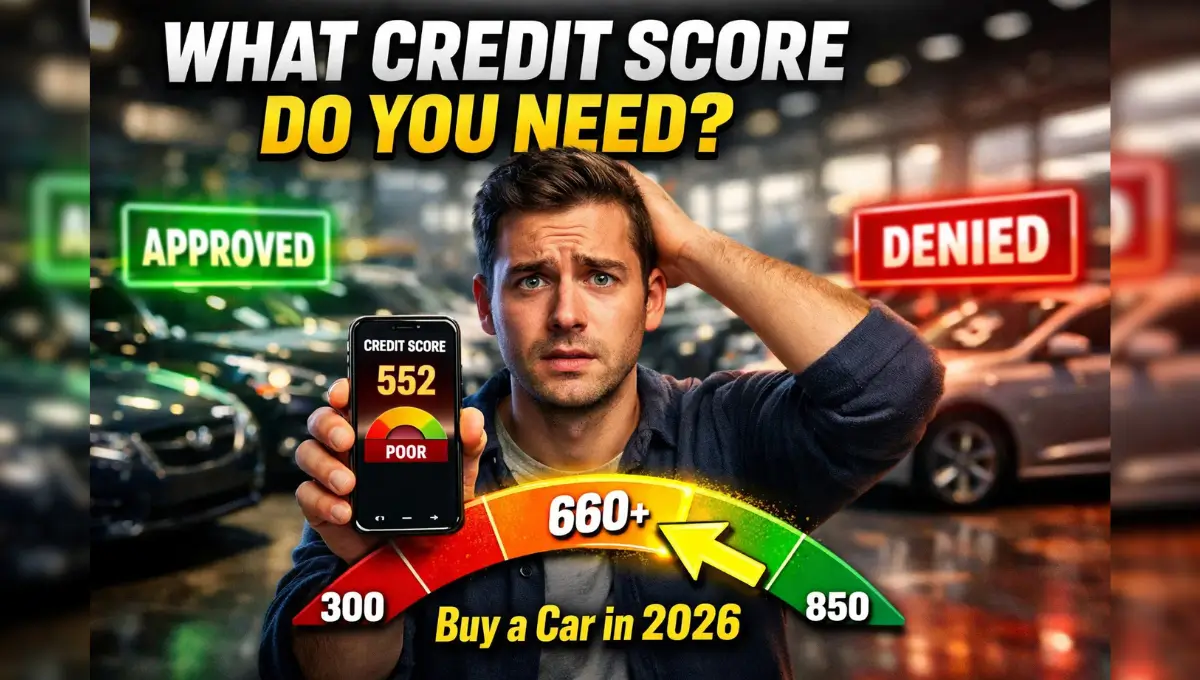
You’re standing at the dealership or scrolling through auto financing websites, and that nagging question won’t leave your mind. What credit score do I actually need to buy a car? Your heart’s pulling you toward that vehicle parked outside, but your credit score feels like it’s holding you back. You’ve heard the whispers that you need perfect credit, that you need a huge down payment, that the whole system is rigged against people like you.
Let me be straight with you. That’s not entirely true. The real story about your credit score for a car loan is more hopeful than you think.
I’ve seen countless people transform their financial lives through smart car buying decisions. What separates those who get stuck with predatory financing from those who drive away with fair terms isn’t luck. It’s understanding the real numbers and knowing how to work with the system, not against it.
1. The Truth About Minimum Credit Score Requirements for Car Loans
Here’s something that might surprise you: there is no official national minimum credit score required to buy a car. Not one. That’s not me being vague. That’s the actual fact from lenders across the country.
What exists instead is something more important than a hard minimum. There’s a practical threshold. Most traditional lenders prefer working with borrowers who have a credit score of 661 or higher. But preferred doesn’t mean required. Think of it like this: preference is where the best opportunities cluster. Requirements are the absolute walls.
The average credit score for someone financing a new car in 2026 is 753. For a used car, it’s 689. These numbers tell you where most of America sits, but they don’t tell you where you need to be. They tell you where it’s comfortable.
What I understand from watching thousands of people navigate this is that the credit score threshold of around 660 marks something real in the lending world. Below this number, you enter what’s called the “near-prime” or “subprime” category. Above it, you’re in “prime” territory. The difference isn’t just academic. It’s measured in dollars. It’s measured in whether you sleep well at night about your purchase.
But here’s what matters most: you can get a car loan at almost any credit score. The question isn’t whether you can. The question is what that loan will cost you.
2. Understanding FICO Auto Score and Why It Matters
When you’re applying for a car loan, lenders might look at multiple scoring models. Your regular FICO credit score is one. Some lenders pull your FICO auto score, which is different. This specialized score ranges from 250 to 900 and focuses specifically on your ability to pay back automotive debt.
Think of a FICO auto score as lenders asking a targeted question: “Based on this person’s history with car payments and similar debts, will they pay this auto loan?” It’s narrower than your general credit score, which tries to predict your behavior across all types of credit.
Some lenders also use VantageScore, another credit scoring model that works slightly differently than FICO. The range is similar (300 to 850), but the calculation emphasizes different factors. If you’re really curious about your specific situation, contact the lender directly and ask which models they use. That conversation itself shows you’re serious about understanding the process, and lenders respond to that.
What I’ve learned from talking with people who’ve successfully navigated car financing is that understanding which score model matters in your specific case puts you in control. Most auto lenders use FICO-based models, but knowing the landscape keeps you from being surprised.
3. Credit Score Ranges and What They Mean for Your Interest Rate
Let me give you the real breakdown of how credit score ranges translate into what you’ll actually pay. These are based on 2026 data, and they’re the truth you need to hear.
Super Prime (781-850):
If you’re sitting here, congratulations. You’re getting the best rates in the market. New car loans typically run 4 to 5 percent APR. Used cars, 5 to 6 percent. Lenders actually compete for your business.
Prime (661-780):
This is the “good” territory. You’re looking at roughly 5 to 7 percent on a new car, 7 to 9 percent on used. You’ll have plenty of lender options, and terms will be reasonable.
Near-Prime (601-660):
Your options narrow here, and costs climb. New cars run 8 to 12 percent APR, used cars 11 to 15 percent. You can still get approved from many places, but you’re definitely paying more.
Subprime (501-600):
This is where things get real. You’re looking at 12 to 18 percent on new cars, 15 to 20 percent on used. Fewer lenders will work with you. Dealership financing becomes more likely. Down payments are bigger.
Deep Subprime (300-500):
Getting approval becomes genuinely difficult. If you do, interest rates can exceed 20 percent. This is where you really need to pause and rebuild before buying if possible.
The difference these ranges make is staggering. On a $25,000 car loan over 60 months, the gap between a 6 percent rate and a 14 percent rate is roughly $5,500 in extra interest. That’s not abstract math. That’s grocery money. That’s your kids’ school activities. That’s breathing room in your budget.
4. How Your Credit Score Translates Into Your Monthly Payment
Numbers on a statement feel distant. Monthly payments feel real. So let me show you exactly how your credit score becomes the money leaving your account each month.
You’re buying a $20,000 used car with no down payment over 60 months. Here’s what different credit scores mean for your actual payment:
With excellent credit (750+), at roughly 6 percent APR, your monthly payment is about $377. Over five years, you pay $22,620 total. Interest costs you $2,620.
With good credit (660-750), maybe 8 percent APR. Your payment jumps to $406. Total cost becomes $24,360. Interest now costs $4,360. That’s $1,740 more you’re paying in interest alone.
With fair credit (550), maybe 14 percent APR. Your payment is now $523. Total cost is $31,380. You’re paying $11,380 in interest. That’s nearly 57 percent of the purchase price going to the lender just for borrowing the money.
Same car. Same loan length. Different credit score. Different life circumstances because of a number.
I’ve had conversations with people who looked at that math and decided to wait three months, improve their score from 590 to 630, and save themselves $2,000 in interest payments. That’s not overstating the impact. That’s the reality.
5. What Happens When You Have Bad Credit for a Car Loan
If you’re sitting with a credit score below 600 and thinking about buying a car, your mind might be spinning with worry. You might think the door is closed. It’s not. But I want you to understand what open means in this context.
With bad credit for a car loan, yes, you can get approved. I’ve seen people get approved with scores in the 540 to 550 range. I’ve watched dealerships finance customers with deep subprime scores and zero down payments. But here’s what that approval comes with.
Higher interest rates, obviously. But also stricter requirements. Lenders typically require larger down payments. Maybe 15 to 20 percent instead of 5 to 10. Your loan term might be limited to 48 months instead of 72, which keeps your monthly payment high. Some lenders require co-signers. Some restrict the age of the vehicle or total mileage.
These aren’t arbitrary restrictions. They’re risk mitigation. From the lender’s perspective, you’re a higher-risk borrower. They’re protecting themselves. Your job is to understand that and negotiate from a position of knowledge anyway.
What I’ve seen work is honesty about your situation combined with proof of stable income. If you can show a lender that you’ve held your job for two years, that you make enough to comfortably cover the payment, that you’re serious about this purchase, doors open that seemed closed.
6. Building Your Score Before You Buy: The Strategic Approach
What if I told you that a 30 to 50 point improvement in your credit score could save you $1,500 to $3,000 in interest over the life of your car loan? Would three months of strategic effort feel worth it?
Most people don’t wait. Most people buy when they need the car. I understand. But if your purchase isn’t urgent, strategic waiting changes the equation entirely.
The highest-impact move is simple: pay everything on time. I mean everything. Your electric bill, your minimum credit card payment, your rent if it reports. Even one late payment can devastate your score. Set up autopay if you struggle with remembering. The friction of automation is worth it.
Your second move is dropping your credit card balances. Credit utilization, the percentage of available credit you’re using, heavily influences your score. Getting balances below 30 percent of your limit helps noticeably. Below 10 percent is even better. If you have a $5,000 limit and owe $4,500, you’re in crisis mode for your score. Get that down to $1,500 and watch your score move.
Third, check your credit report for errors. Go to AnnualCreditReport.com. It’s free, and it’s the official way. Look for accounts that aren’t yours, payments marked late that you made on time, balances that are incorrect. Dispute them. Honest errors get removed faster than you’d expect.
Finally, avoid new credit applications. Each application generates a hard inquiry that temporarily lowers your score. Yes, multiple auto loan inquiries within 14 days count as one. But that doesn’t mean it’s zero impact. Hold off on new credit cards, new personal loans, anything with a hard pull for the months before your car purchase.
7. Alternative Paths: Getting Approved With Less Than Perfect Credit
Sometimes you can’t wait. Sometimes you need a car now. A broken transmission makes a job impossible. Your current vehicle is unreliable. Life doesn’t always give you the luxury of three months to improve your score.
That’s when alternative paths matter.
Work with credit unions before traditional banks. Credit unions consistently offer lower rates than banks and often have more flexible approval standards. If you have a relationship with one, use it. If not, some let you join based on your employer or geographic location.
Consider a co-signer with better credit. If someone trusts you enough to guarantee the loan, your approval odds improve and your rate likely drops. Be honest that this puts them at risk if you don’t pay. That conversation is crucial.
Put down more money upfront. A larger down payment does two things. It reduces the amount you need to borrow, which lowers the lender’s risk. It also shows you’re serious and financially committed. If you can manage 20 percent down instead of 5 percent, lenders take notice.
Choose a shorter loan term if possible. Seventy-two-month loans are common because the lower monthly payment helps people qualify. But shorter terms, even 60 months instead of 72, often come with lower rates. Your payment is higher monthly, but your total interest is lower.
Buy a used car instead of new. The average credit score for used car financing is lower (689 versus 753) because lenders understand lower-priced used cars represent lower risk. You’re not making some grand compromise. You’re being strategic.
One more option that surprises people: some dealerships have in-house financing or relationships with subprime lenders. I know, the rates are higher. But the approval is possible, and you can refinance later when your credit improves. Some people use this as a bridge strategy, buy the car, make every payment on time for a year, then refinance with a traditional lender at a better rate.
Also read:- Best Student Loan Payoff Strategies for 2026: Snowball vs Avalanche, Refinance & Forgiveness
8. Making Your Credit Score Work for You in 2026
Here’s what I want you to understand more than anything. Your credit score isn’t a life sentence. It’s not a judgment on you as a person. It’s a number that reflects your recent behavior. And numbers change.
Every on-time payment moves it up. Every late payment moves it down. But here’s what most people miss: the movement isn’t proportional. Your most recent behavior matters more than what happened two years ago. Your recent positive momentum matters more than old negative events.
This means you can feel stuck now and genuinely unstuck six months from now if you’re intentional. I’ve watched people go from “I’ll never get approved” to “I can’t believe the rate I got” inside a year. The change is real.
When you’re shopping for a car loan, armed with knowledge of what your score qualifies for, you have power. You know what rate you should be able to get. You can compare it to what you’re being offered. You can walk away if something doesn’t make sense.
Get pre-approved from your bank or a credit union before stepping into a dealership. This locks in a rate and gives you a number to compare against dealer financing. Dealers often try to beat the pre-approved rate to earn your business. Sometimes they succeed. Sometimes you’re better off using your original financing. Either way, you’re comparing numbers, not guessing.
Use the 14-day shopping rule. When multiple lenders pull your credit in a 14-day window for the same type of credit (car loans), they count as a single inquiry. This protects you. You can shop around without destroying your score.
Real-Life Example: How This Actually Works
Marcus came to me with a 580 credit score. He’d gone through some tough years financially, missed some payments, and his credit reflected it. He needed a reliable vehicle for his job, and his old car was becoming a liability.
Most places looked at his score and started talking about rates above 15 percent. One dealer threw around 18 percent. Marcus was about to accept it when he remembered what he’d learned.
He got pre-approved with a credit union. The rate was 11 percent. It wasn’t perfect, but it was a massive difference. Over 60 months on a $15,000 loan, the difference between 18 percent and 11 percent is roughly $3,300. That’s substantial money.
Marcus made every payment on time for 12 months. His score moved from 580 to 620. He called the credit union about refinancing. They knocked his rate down to 9.5 percent. He paid off the refinanced loan with about $1,800 less in interest than he would have paid at 11 percent.
Start to finish, Marcus paid nearly $5,000 less than if he’d accepted the first offer. How? Knowledge. Patience with the right parts. Execution on what mattered.
FAQ Section
Q: What’s the highest credit score for a car loan?
A: The highest FICO score is 850. For auto scoring specifically, the FICO Auto Score caps at 900. Anything above 780 puts you in “super prime” territory where you’re getting the absolute best rates available. The actual ceiling matters less than understanding that improvement beyond 750 brings minimal rate improvements. Focus on getting above 661 first.
Q: What credit score do you start with when you first establish credit?
A: You don’t start with a score. You don’t have any credit score until you’ve borrowed money and paid it back. The first time you might check your score after opening your first credit account, it might be anywhere from the 300s to the 600s depending on your initial behavior. This is why young adults often struggle with car loans. They have minimal credit history. Building that history with a credit card or small secured loan before applying for a car loan helps tremendously.
Q: Is 650 a good credit score for a car loan?
A: A 650 score puts you in “fair” territory but right on the edge of something better. You’re in the near-prime range where approval is likely from many lenders, but your interest rates will be noticeably higher than prime borrowers. You’re not locked out, but you’re paying for the risk. If you can wait three months and push toward 670, the rate improvement is worth the delay.
Q: Can I get a car loan with bad credit for a car loan?
A: Yes, absolutely. Even with scores in the 550 range, some lenders will work with you. The question isn’t can you, but what will it cost you and are there better alternatives. Dealership financing, credit unions with looser standards, and second-chance auto loans all exist. The rates are higher, but the option exists.
Q: What is a FICO auto score and how does it differ from regular credit score?
A: Your FICO Auto Score (ranging from 250 to 900) focuses specifically on your history with installment loans like car loans. It’s calculated differently than your general FICO score and emphasizes factors lenders care about most when deciding on auto lending. Many auto lenders pull this score alongside your regular FICO. If you have a strong history with auto loans but a lower overall credit score, your FICO Auto Score might be better.
Q: How do I improve my credit score fast before applying for a car loan?
A: The fastest improvements come from reducing credit card balances (directly impacts credit utilization), making every payment on time (prevents new negative marks), and disputing errors on your credit report. These can combine to improve your score 30 to 50 points in 60 to 90 days. Credit builder loans and certain credit cards designed to help rebuild credit also accelerate improvement. It takes intention, not magic.
Q: Should I buy a car with a low credit score or wait to improve it first?
A: If your purchase isn’t urgent, waiting three to six months to improve your score from 600 to 650 or 660 will save you thousands in interest. If you genuinely need the car now, buy it strategically with the tools available (larger down payment, co-signer, credit union financing) and plan to refinance once your score improves.
Your Path Forward in 2026
Understanding your credit score for a car loan isn’t about shame. It’s about clarity. It’s about knowing what you’re facing and having a real plan for moving forward.
Your score is not your identity. It’s a number that reflects your financial behavior, and numbers can change. Every single on-time payment moves it in the right direction. Every month you don’t miss a deadline is a month you’re building momentum.
If you’re standing where Marcus was, in the 550 to 600 range, that’s not the end of your story. That’s the chapter where you make better decisions. That’s the moment when you decide to be intentional about borrowing. That’s when you stop accepting the first offer and start looking for what you actually deserve.
My respects to everyone who’s working to understand their credit score and take control of their car buying experience. You’re doing harder work than people with perfect scores. You’re fighting against numbers that make things harder. And yet you’re still moving forward, still seeking solutions, still pushing toward better. That takes the kind of character that lenders should be rewarding and that life rewards eventually. Your credit score is just paper. Your determination is what matters. Keep moving forward.
Disclaimer: This article is for educational and informational purposes only. It is not financial, investment, or legal advice. Always consult a qualified financial advisor before making any financial decisions.

Richard Patterson is the founder of Payoff Hustle. With over 8 years of experience in personal finance and online income, he has helped thousands of people build profitable side hustles while working full-time jobs.