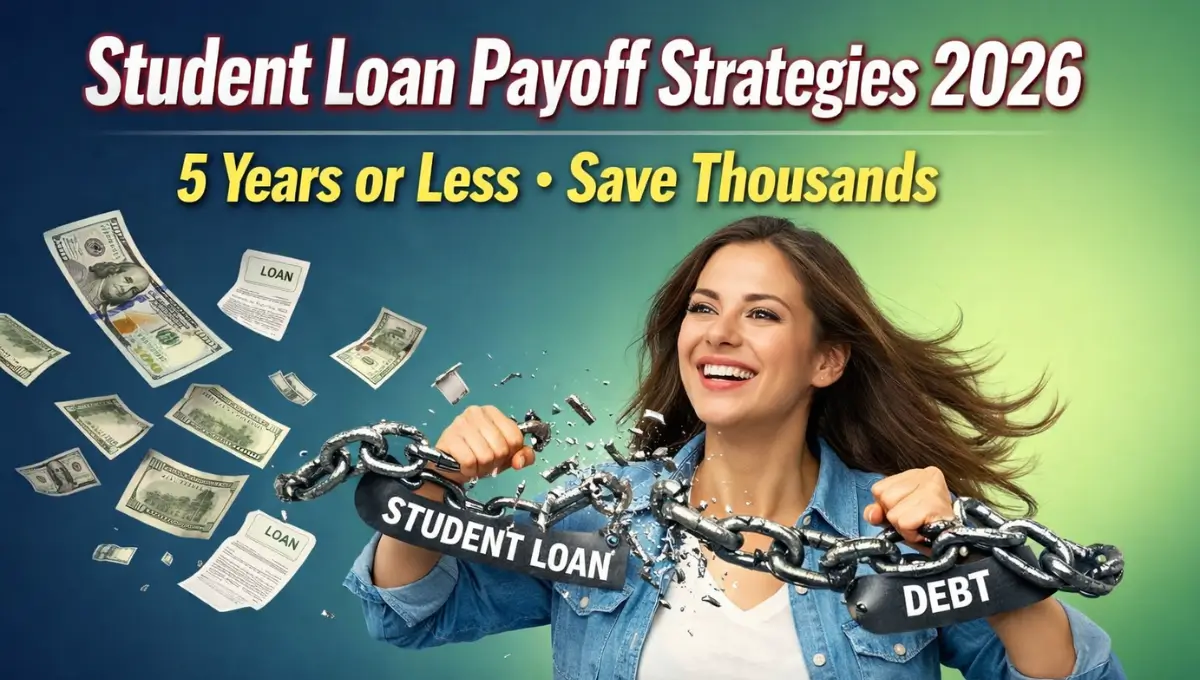
You’re not alone. The average graduate carries nearly $29,300 in student loan debt. Some people owe more. Some owe less. But for millions of Americans, that student loan balance feels like a weight they’ll never escape. It’s there when you wake up. It’s there when you check your account balance. It’s there when you think about your future.
Here’s what I want you to know: you don’t have to feel trapped forever. The strategies that work best don’t require you to be rich or lucky. They require consistency and the right approach. And in 2026, there are more options than ever before to accelerate your payoff.
1. Understanding Your Loans: The Foundation of Everything
Before you can choose a strategy, you need to know what you’re working with. Go pull up your account at studentaid.gov if you have federal loans. For private loans, check your statements.
Write down everything:
- Each loan type (federal subsidized, federal unsubsidized, federal PLUS, private)
- Current balance on each
- Interest rate (APR)
- Current repayment plan
- Monthly payment amount
- Total amount owed across all loans
This sounds basic, but most people never actually do this. They vaguely know they have “a lot of debt” without understanding the specifics. You’re going to be different.
Federal loans typically offer protections that private loans don’t. Fixed interest rates. Income-driven repayment options. Forgiveness programs. Deferment and forbearance options. You want to understand what you have because your strategy might be completely different for federal loans versus private loans.
The average borrower takes more than 20 years to pay off student loans. But you’re not going to be average. You’re going to be intentional.
Also read:- 7 Real Ways to Pay Off Debt in 2026: Your Complete Roadmap Out of Financial Stress
2. The Debt Snowball vs. Debt Avalanche: Which Strategy Fits You
There are two main approaches. Both work. Which one is right depends on your personality and what keeps you motivated.
The Debt Snowball Method: Psychology First
List your loans from smallest to largest balance (ignore interest rates). Make minimum payments on everything. Throw every extra dollar at the smallest loan.
When that’s paid off, take the payment you were making and add it to the next smallest loan’s minimum payment. Keep rolling.
Why this works: You get quick wins. Paying off that $2,500 private student loan in six months feels real. It builds momentum. You see proof that your strategy works before you move to the bigger loans.
The snowball method prioritizes your emotional engagement over mathematical efficiency. Research from Harvard and Northwestern shows people stick with this method longer because they feel progress immediately.
The Debt Avalanche Method: Mathematics First
List your loans by interest rate (highest to lowest). Make minimum payments on everything. Attack the highest-rate loan with everything extra.
Once that’s gone, move to the next highest rate.
Why this works: You pay the least total interest over time. If you have a private loan at 8% and a federal loan at 4.5%, attacking the 8% first saves you real money. Over 10 years, that difference could be thousands of dollars.
The avalanche method is mathematically optimal. If you’re the type of person motivated by seeing the numbers work in your favor, this is your strategy.
Which One Should You Choose?
If you need quick wins to stay motivated, snowball all day. If you’re mathematically minded and disciplined, avalanche. The best strategy is the one you’ll actually follow for the next 5, 10, or 20 years.
3. Making Extra Principal Payments: The Real Game-Changer
This is the single biggest lever you have. The difference between paying minimum and paying extra is literally the difference between 20 years and 5 years.
Here’s why it works: Interest accrues daily. Every day your balance sits there, more interest attaches to it. By paying down the principal faster, you’re reducing the amount interest can accrue on.
Real Numbers:
$30,000 balance at 5.5% interest rate
- Minimum payment ($300/month): Paid off in 117 months (nearly 10 years), total interest paid $5,100
- $400/month payment: Paid off in 77 months (6.4 years), total interest paid $2,000
- $500/month payment: Paid off in 60 months (5 years), total interest paid $1,100
- $600/month payment: Paid off in 51 months (4.25 years), total interest paid $600
See the difference? Going from $300 to $500 monthly takes 5.4 years off your payoff timeline and saves you $4,000 in interest. That’s life-changing.
How to Find Extra Money:
Every side hustle counts. Freelancing, delivery driving, tutoring. Even $100 extra monthly cuts months off your payoff.
Tax refunds go to principal, not vacation. Annual bonuses go to principal. That raise you get next year? Half of it to principal.
Budget cuts matter too. That $150/month eating out becomes $150/month to student loans. Over 10 years, that’s $18,000 less owed.
The Critical Rule:
Specify that your extra payment goes directly to principal. If you don’t, the loan servicer might apply it to next month’s minimum payment or interest. Call and confirm they’re putting extra money toward principal.
4. Biweekly Payments: The Simple Trick That Works
Here’s a sneaky strategy that works without completely changing your budget: split your monthly payment in half and pay biweekly.
Example: Instead of one $300 payment per month, you pay $150 every two weeks.
What happens? By the end of the year, you’ve made one extra full payment without even feeling it. The payment happened naturally through the biweekly schedule.
Why it works: Interest is calculated daily. Paying every two weeks instead of once a month reduces your average daily balance throughout the year. Less balance equals less interest.
Over 10 years, this one simple change could save you $500 to $2,000 depending on your loan size and interest rate. It’s free. It takes 5 minutes to set up. And it actually works.
5. Student Loan Refinance: When It Makes Sense
Refinancing means taking out a new loan to pay off your old ones. You consolidate everything into one new loan with (hopefully) a better interest rate.
When Refinancing Makes Sense:
Your credit score has improved since you took out the original loans Interest rates have dropped You want a shorter repayment term You have private loans (federal loans might lose important protections)
When Refinancing Doesn’t Make Sense:
You have federal loans and plan to pursue forgiveness programs You need the income-driven repayment flexibility of federal loans Your credit is still recovering You have a cosigner on your original loans and want to remove them
Important: Many private lenders offer no-fee refinancing, so you can shop around. But federal loans have protections private loans don’t. If you refinance federal loans, you lose access to income-driven repayment plans and loan forgiveness options like Public Service Loan Forgiveness (PSLF).
Real Scenario:
You have $50,000 in student loans at 6.5% interest on a 10-year plan ($530/month). You refinance to 4.5% interest on the same 10-year plan. Your new payment is $475/month. You just freed up $55 monthly ($660/year) without changing anything else about your life.
That $55 becomes extra principal payment on your refinanced loan, cutting months off your payoff.
6. Leverage Student Loan Consolidation Strategically
Consolidation combines multiple federal loans into one new Direct Consolidation Loan. You get one payment instead of many.
The interest rate becomes the weighted average of your original loans’ rates. So you don’t get a lower rate but you get simplicity.
When Consolidation Helps:
You have multiple federal loans and want one payment You want to access income-driven repayment plans for federal loans You want to pursue PSLF and need Direct Loans specifically You’re juggling too many due dates
The Tradeoff to Know:
You might lose any benefits attached to your original loans (like rate discounts). You also lose any progress you’ve made toward PSLF if you consolidate.
Consolidation itself doesn’t speed up payoff. It just simplifies things. But simplification matters because it’s easier to stick with a strategy when you only have one payment to manage.
7. Income-Driven Repayment Plans: Your Safety Net
Federal student loans offer income-driven repayment (IDR) plans. Your monthly payment is based on your income and family size, not on how much you owe.
This matters when:
- You’re unemployed or underemployed
- Your income is very low compared to your debt
- You need flexibility in monthly payments
Important 2026 Change:
Starting July 1, 2026, most existing income-driven plans are being phased out and replaced with one primary plan called the Repayment Assistance Plan (RAP). This plan bases your monthly payment on 1-10% of your income (depending on your family structure) and includes forgiveness after 30 years of payments.
Current Plans (Being Phased Out):
- PAYE (Pay As You Earn): 10% of discretionary income, forgiveness after 20 years
- IBR (Income-Based Repayment): 10-15% of discretionary income, forgiveness after 20-25 years
- ICR (Income-Contingent Repayment): Based on income or fixed amount, forgiveness after 25 years
- SAVE (Saving on a Valuable Education): New plan, more generous, forgiveness after 20-25 years
If you’re currently in one of these plans, you don’t have to change immediately. But you’ll need to choose a new plan by July 1, 2028.
Income-driven plans give you breathing room. If you’re struggling financially, you can get your monthly payment down to what you can actually afford. The downside? You’ll pay more total interest over the longer repayment period. But it beats defaulting on your loans.
8. Student Loan Forgiveness Programs: The Hidden Path
Some people will get massive portions of their debt forgiven. Are you one of them?
Public Service Loan Forgiveness (PSLF):
- Work for a government agency or nonprofit (501c3)
- Make 120 qualifying monthly payments
- Be enrolled in an income-driven repayment plan
- After 120 payments (10 years), remaining balance is forgiven
You could work at a public school, the Department of Veterans Affairs, a nonprofit hospital, a nonprofit social justice organization, the federal government, or thousands of other qualifying employers.
If you’re earning $35,000/year and have $60,000 in loans, PSLF might mean you actually pay back only $20,000 over 10 years and the remaining $40,000 gets forgiven. That’s not paying off your loans that’s using the system strategically.
Teacher Loan Forgiveness:
Teach full-time for 5 consecutive years in a low-income school Get up to $17,500 forgiven
Nurse Corps Loan Repayment:
Healthcare professionals serving in underserved areas Up to $50,000 in loan repayment assistance
Military Service Repayment:
National Health Service Corps Loan Repayment Program and others
The Critical Strategy:
Don’t ignore forgiveness programs. If you qualify for PSLF, you might not want to pay off your loans aggressively. You might want to make minimum payments and let the forgiveness program handle the rest.
But only pursue forgiveness programs if you’re actually committed to the job long-term. You need 10 years of qualifying payments for PSLF. Walk away early and you lose the benefit.
9. Employer Student Loan Repayment Assistance: Free Money You’re Probably Ignoring
This is the strategy most people miss: asking your employer for help.
Here’s What Employers Can Do (2026 Update):
- Contribute up to $5,250 annually per employee toward student loan repayment
- The money is tax-free to you
- This is now permanent under the “One Big Beautiful Bill” passed in 2025
Companies Offering This Benefit:
- Fidelity: Up to $15,000 lifetime maximum
- Ally: $100/month toward student loans (up to $10,000 lifetime)
- Google: $10,000+ in assistance
- SoFi: Employer repayment programs
- PwC: Substantial repayment assistance
- Chegg: $1,000 annual grant plus Equity for Education program
- Clayco: $100-$250/month depending on tenure
About 36% of employers now offer student loan repayment assistance. That’s an increase from just 4% a few years ago. The number keeps growing.
How to Check If Your Employer Offers It:
Ask your HR department. Check your employee benefits handbook. Look at the company website’s benefits section. Call HR directly and ask if they offer educational assistance programs that cover student loan repayment.
If they don’t offer it, propose it. Say something like: “I know many employers offer student loan repayment assistance as an employee benefit. Has [Company] considered this? It would help me focus on my work instead of financial stress.”
What This Actually Means:
If your employer gives you $5,250/year toward student loans, that’s $5,250 you don’t have to pay. Over 10 years, that’s $52,500 paid by your employer instead of you. That could literally cut your payoff timeline in half.
10. The Autopay Discount: Small But Real
Federal student loan servicers offer a 0.25% interest rate reduction if you sign up for automatic payments from your bank account.
It sounds small. And it is. A $10,000 loan at 4.5% APR with autopay discount becomes 4.25%. Over 10 years, that saves about $144.
But it’s free. It takes 5 minutes. And combined with other strategies, it adds up.
Private lenders often offer autopay discounts too. Sometimes even bigger ones. Shop around when you’re looking at refinancing options.
11. How to Pay Off Student Loans When You’re Broke
This is where most people are: barely keeping up with minimum payments and wondering if they’ll ever escape.
Real talk: you don’t need extra money to improve your situation. You need a different strategy.
Option 1: Pursue Income-Driven Repayment
If you have federal loans and low income, income-driven repayment might reduce your payment to nearly nothing. You pay what you can actually afford. The interest still accrues, but at least you’re not in default.
Once your income improves (and it will), your payment increases automatically. But right now, you get breathing room.
Option 2: Check For Employer Assistance
Even broke people usually have jobs. Ask your employer if they offer student loan assistance. Sometimes they do and people just don’t know about it.
Option 3: Explore Forgiveness Programs
If you work in public service, education, healthcare, or other qualifying fields, forgiveness programs might eventually wipe out your debt. You don’t have to pay it off if you take a long-term job in a qualifying field.
Option 4: Use Side Income When It Comes
You might be broke now, but you’ll get tax refunds, occasional bonuses, or small windfalls. Put 100% of that toward loans. It feels like found money because it is.
Option 5: Accept That It Takes Time
If you’re making minimum payments on limited income, you’re not going to pay off $30,000 in student loans in 2 years. That’s not realistic. But you might pay it off in 10-15 years if you’re consistent. That’s still a win.
The people who fail are the ones who give up. The people who succeed are the ones who stay consistent even when progress feels slow.
12. How to Pay Off Student Loans in 5 Years (Or Less)
This is aggressive. It requires commitment. But it’s possible.
The Math:
- $100,000 in student loans, 5.5% average interest rate
- To be debt-free in 5 years, you need to pay approximately $1,887 monthly.
- If your minimum payment is $1,100, you need to find $787 extra monthly.
How Actually Do This:
- Multiple income streams. You have your job. Now add a side hustle. $500-800/month from a second income source is realistic.
- Cut discretionary spending aggressively. That’s not budgeting—that’s lifestyle change. No eating out. No streaming subscriptions. No new clothes. Just basics.
- Use every windfall. Tax refund? Bonus? Side hustle? All goes to principal.
- Skip major expenses. If you’re planning a wedding, vacation, or expensive car purchase, pause it until loans are gone. You can celebrate when debt is actually gone.
- Refinance if rates drop. Even a 1% rate reduction cuts significant time and money off your payoff.
Real Example:
- You earn $60,000/year at your job ($5,000/month after taxes).
- You pick up a side hustle earning $800/month.
- You cut discretionary spending by $400/month.
- That’s $1,200 extra monthly beyond minimum payments.
With a $30,000 loan balance at 5.5%, that gets you out in under 3 years instead of 10.
Is it hard? Yes. Is it worth it? Ask anyone who’s done it. The stress relief alone is worth the sacrifice.
13. Best Way to Pay Off Different Interest Rates
You have three loans at different rates. Which one do you attack first? The answer depends on your strategy.
If You’re Using Debt Avalanche:
Pay highest interest rate first. That’s non-negotiable. If you have a 7.5% loan and a 4% loan, the 7.5% gets attacked.
Why? Every month that 7.5% accrues more interest than the 4% loan. Eliminate it first and you’re saving serious money.
If You’re Using Debt Snowball:
Pay smallest balance first, regardless of rate. That $2,000 loan at 4% gets paid first, even if you have a $8,000 loan at 3%. You need that psychological win.
The Interest Rate Rule of Thumb:
If your student loan interest rate is higher than 6%, prioritize paying it off over investing. If it’s lower than 6%, you might be better off investing and making minimum payments.
But this is just math. Your emotional wellbeing matters too. If having debt gone makes you sleep better, you might want to pay off even 4% loans aggressively.
Real Situation – Mixed Rates:
- Federal loan 1: $15,000 at 4.5%
- Federal loan 2: $8,000 at 5.8%
- Private loan: $12,000 at 7.2%
Using avalanche: Attack the 7.2% private loan first. Once that’s gone, move to the 5.8% federal loan.
Using snowball: Attack the $8,000 federal loan first (smallest balance). Get that win, then move to the $12,000 private loan.
Both strategies work. Choose based on what keeps you motivated.
Real-Life Timelines: What Actually Happens
Scenario 1: Standard Payoff
- $30,000 debt, 5.5% interest, $300/month minimum payment
- Timeline: 117 months (9.75 years)
- Total interest paid: $5,100
- Strategy: Just make minimum payments and forget about it
Scenario 2: Moderate Extra Payments
- Same $30,000 debt, but paying $400/month
- Timeline: 77 months (6.4 years)
- Total interest paid: $2,000
- Strategy: Find $100 extra monthly, add to minimum
Scenario 3: Aggressive Payoff
- Same $30,000 debt, but paying $600/month
- Timeline: 51 months (4.25 years)
- Total interest paid: $600
- Strategy: Side hustle + budget cuts = $300 extra monthly
Scenario 4: Using Employer Assistance
- Same $30,000 debt, $400/month payment + $400/year employer repayment assistance
- Timeline: Approximately 5 years
- Total interest paid: ~$1,500
- Strategy: Employer pays $400 annually (tax-free), you pay $400/month
Which scenario appeals to you? Your answer determines your strategy.
Your Action Plan for 2026
This week:
- List all your loans (balance, rate, servicer)
- Decide: snowball or avalanche?
- Ask your employer about loan repayment assistance
Next week:
- Set up autopay (get 0.25% discount)
- Calculate how much extra you can realistically pay monthly
- Set up automatic extra payments if possible
This month:
- Review income-driven repayment options (federal loans)
- Check if you qualify for forgiveness programs
- Consider refinancing if rates dropped since you took out loans
This quarter:
- Track your progress
- Celebrate your first small win (first loan paid off or $5,000 paid down)
- Adjust your strategy if it’s not working
FAQ: Your Questions Answered
Q: Should I focus on student loans or investing?
A: If your loan rate is above 6%, prioritize loans. If below 6%, you might get better returns investing. But emotionally, being debt-free matters. There’s value in that peace of mind.
Q: Does paying off student loans early hurt my credit?
A: You might see a small temporary dip, but paying off debt strengthens your credit long-term by lowering your debt-to-income ratio. Overall, early payoff is excellent for your credit health.
Q: Can I pay extra without penalty?
A: Federal loans have zero prepayment penalties. You can pay extra anytime without any fees. Same with most private loans. But check your note some older private loans might have penalties.
Q: What happens if I can’t make payments?
A: Contact your loan servicer immediately. Don’t ignore it. You have options: deferment, forbearance, or income-driven repayment. All are better than default.
Q: Is loan forgiveness really possible?
A: PSLF is real, but requires specific employment for 10 years. Teacher forgiveness is real for teachers. Forgiveness programs are real, but don’t count on them plan to pay. If you get forgiveness, it’s a bonus.
Q: Should I refinance federal loans?
A: Only if you’re not pursuing forgiveness and you’ve secured a significantly lower rate. Refinancing federal loans as private loans loses important protections.
Q: How do I know if my employer offers assistance?
A: Check your benefits handbook. Ask HR directly. Look on the company intranet. It’s free to ask.
Q: What if I have multiple private loans?
A: You can refinance them all into one new loan, consolidating into a single payment. This simplifies things but doesn’t necessarily lower your rate (only if rates have dropped).
The Truth About Student Loan Payoff
Paying off student loans is not romantic. It’s not exciting. It’s boring, consistent, unglamorous work.
But you know what is exciting? Paying off that last loan. Getting a statement that says “Balance: $0.” Knowing you don’t have a monthly payment anymore. Having an extra $300, $400, or $500 monthly that’s yours to keep.
That moment is worth the sacrifice.
You’re going to do this. Not because you’re special or lucky. But because you’re going to pick a strategy, stick with it consistently, and adjust when needed.
The average 20-year payoff timeline isn’t your timeline. You’re choosing to be done faster.
That’s not luck. That’s intention.
Disclaimer: This article is for educational and informational purposes only. It is not financial, investment, or legal advice. Always consult a qualified financial advisor before making any financial decisions.

Richard Patterson is the founder of Payoff Hustle. With over 8 years of experience in personal finance and online income, he has helped thousands of people build profitable side hustles while working full-time jobs.
2 thoughts on “Best Student Loan Payoff Strategies for 2026: Snowball vs Avalanche, Refinance & Forgiveness”